


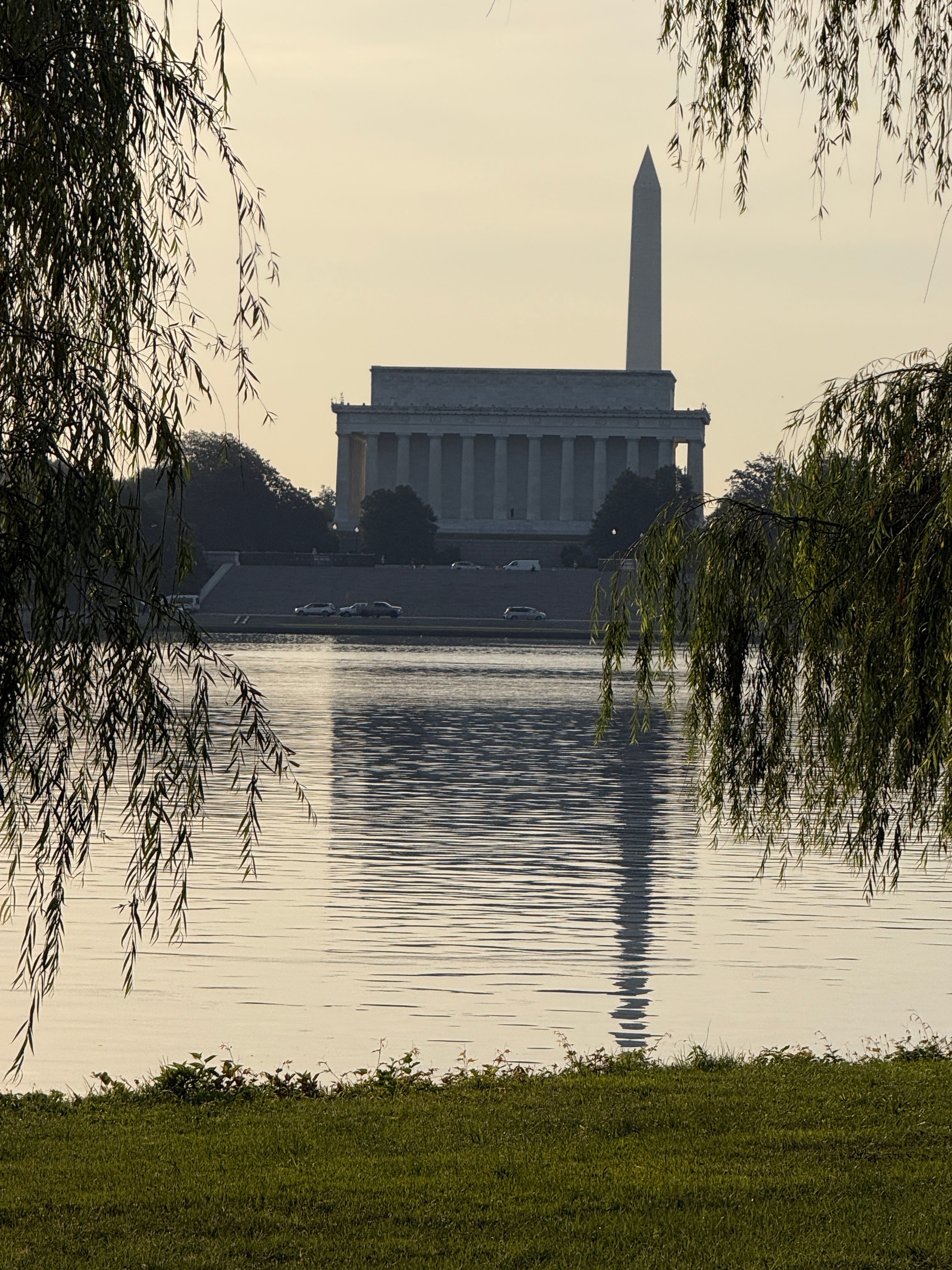
We set out to walk four miles. It took us nearly an hour to begin.
I overslept. Her Uber left her at the wrong trailhead. There were texts, phone calls, apologies, rerouted directions, and a reasonable case for trying again another day. We found each other anyway, and by then neither of us was in a hurry.
We spent the next hour or so walking the Mount Vernon Trail, talking about the subjects that arrive with midlife: aging parents, changing bodies, the habits we are trying to keep, the ones we are trying to leave behind, and health as preservation rather than appearance.
The Potomac was unusually still that morning. A light breeze moved across the trail, even with the city behind us buzzing with traffic, agendas, and deadlines. The quiet did not make the city disappear. It simply gave us enough distance from it to notice what ordinarily gets crowded out.
At one point the conversation turned to memory. She spoke about her mother’s dementia. My family has been through it too. We compared the things we now do with something close to discipline: walking, reading, sleeping, watching what feeds the mind as much as the body. All of it in service of staying recognizable to ourselves.
Memory is not only recollection. It is continuity: the mechanism by which a person remains the same person from one day to the next. We take it for granted until we have reason not to. We move through most days assuming that the people, experiences, and versions of ourselves we carry will remain available to us. Without it, a person can become difficult to recognize, including to herself.
What stayed with me was the shape of it. Her mother’s record has not vanished. It has relocated into the people who love her, even when she cannot reach it herself.
Institutions do not lose memory as people do. But they live with a related asymmetry: much of what they are known for is held in the memories of other people, and they are often the last to recognize what has endured.
Organizations spend enormous amounts of time thinking about visibility. They invest in messaging, campaigns, positioning, and new ways of reaching people. Yet reputation is rarely built at the moment a message is delivered. It is built through accumulation.
People remember whether an organization kept its promises. They remember how it behaved when trust was tested. Those memories accumulate into reputation, and the organization does not control them.
But reputation is shaped not only by what people remember, but by what memory allows to fade. The selection is rarely deliberate. Some moments set and stay: the first disappointment; the promise kept when breaking it would have been easier; the moment an institution offered care, or did not. Other moments fade, including many of the achievements an organization celebrates most.
This is one reason familiar communications strategies fail. They are designed to persuade in the present. Reputation is made largely of the past as others remember it, and that memory is not available for institutional revision.
Institutions that handle this well treat reputation as a discipline rather than an instinct. They know that every decision can become evidence held in the memories of employees, donors, partners, journalists, and communities, often unexamined until a consequential moment calls it forward.
When that happens, organizations often believe they are responding to a single event.
Their stakeholders are responding to years.
That is the reason this publication exists. For most of my career, I have worked inside institutions whose authority depended on public confidence. My work was to help leaders think clearly about reputation, crisis, positioning, and brand trust. Over time, I became less interested in what organizations should say and more interested in why some are believed and others are not, including some that say everything correctly.
On Repute is where I intend to work on that question in public. Some essays will develop frameworks for leaders confronting questions of institutional credibility. Others, like this one, will begin somewhere ordinary and follow the question where it leads.
We finished nearly four miles eventually.
The walk ended, but the conversation did not. It stayed with me because memory is not only what we retain for ourselves. It is also what others retain of us.
Institutions are no different. Their reputation is the record other people carry of them, whether or not the institution ever learns to read it.
Editorial note: This essay was written by Shrita Hernandez and edited with the assistance of AI. The argument, analysis, and final judgment are the author’s own.