


Picture the room after a crisis response has landed badly. The statement is on the screen. Someone is asking whether it should have gone out at 9:14 or 9:04. Someone else is defending the spokesperson’s tone while legal walks through what was and was not said. It is a competent postmortem and will yield useful corrections. But everything under examination happened after the conditions shaping the response had already been set.
No one in that room is asking what the audience believed at 9:00 a.m. before a single word was drafted. That belief had been forming for months or years through commitments kept and unkept, claims supported and unsupported, encounters that confirmed what the organization said about itself and encounters that quietly contradicted it. By the time the statement appeared, the audience was reading it against an accumulated record of experience. Whether it landed as reassurance or as confirmation of what people already suspected depended on that record.
In PR Daily, I called that gap credibility debt: the accumulating gap between an organization’s claims and the evidence required to make belief reasonable. I described four forms it can take: promise debt, proof debt, relationship debt, and decision debt. That taxonomy identifies where the liabilities sit. A different question lies beneath it: why can capable leaders spend years inside an organization without seeing the total clearly? The answer begins with two sets of books.
Two sets of books
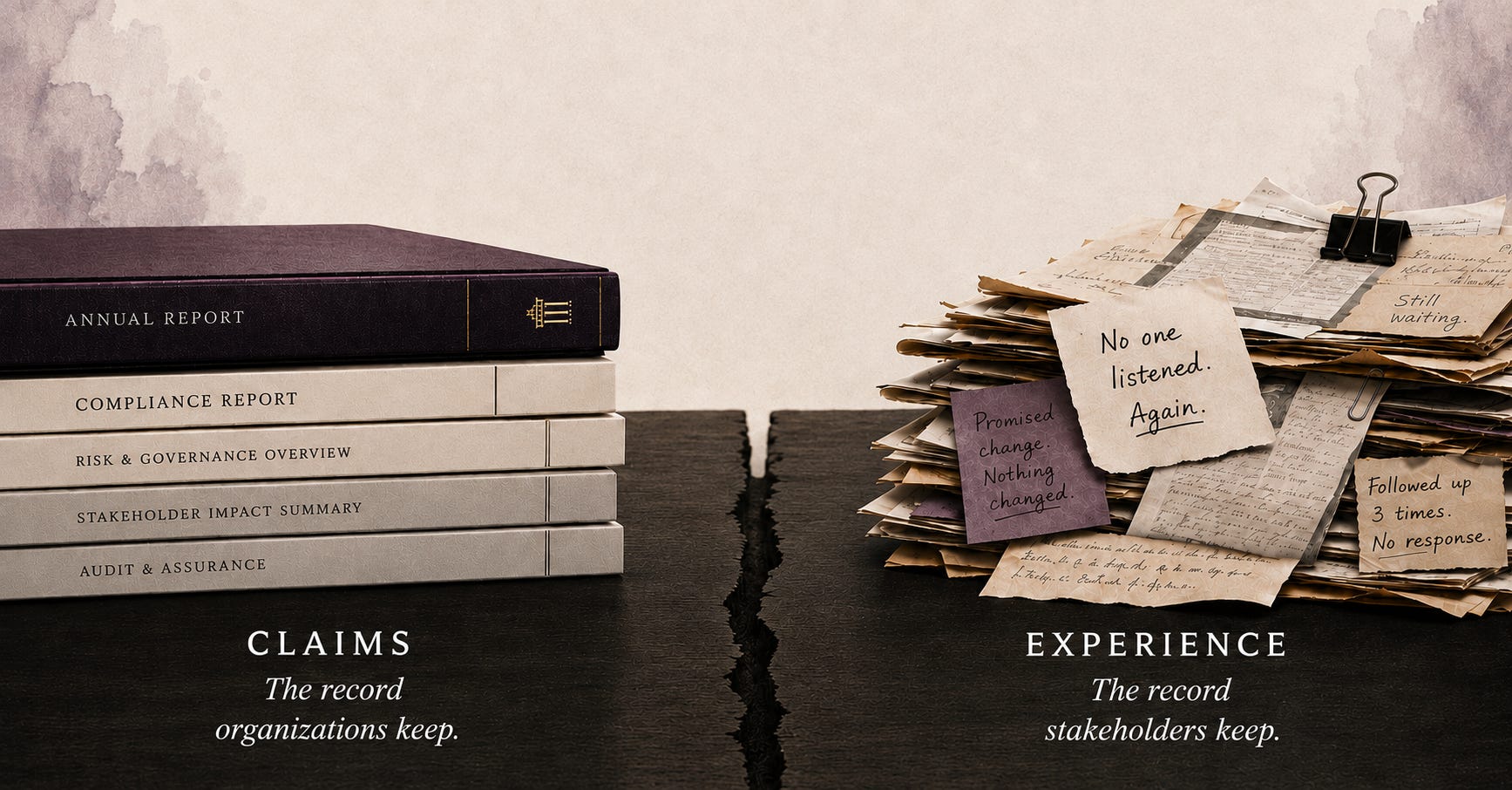
An organization keeps its books in claims, and everyone else keeps theirs in experiences. The organization’s record contains what it said, committed to, published, announced, and intended. The stakeholder’s record contains what happened: what arrived, what did not, how long the answer took, and whether a commitment survived contact with ordinary experience. Both records are accurate on their own terms, and neither is legible to the other.
They are created differently. A public commitment enters the institutional record at a specific moment through a document, announcement, report, policy, speech, or decision. Experience accumulates continuously through interactions too small to attract executive attention on their own. An organization, therefore, keeps an orderly archive of what it has said, while the people around it accumulate a messier account of what those statements have meant in practice.
Credibility debt remains invisible because no function is charged with bringing the two records into the same view. Claims are recorded in one system, experiences in another, if they are recorded at all. An organization can know a great deal about what it has promised and still have no reliable view of what those promises have become in the lives of the people receiving them.
The institutional ledger is authored and interpreted by the people with the most reason to read it generously. The team that wrote a community-access commitment knows the budget constraints, the internal debate, the compromises, and the effort that went into delivering what was possible. A year later, those facts shape how the team evaluates the commitment. The person waiting for access has a different record, built around what was promised and what happened.
Ownership creates another blind spot. Public claims sit inside functions, programs, initiatives, and leadership portfolios, so each part of the organization is responsible for a piece of what stakeholders eventually experience. One group knows what was announced, another what was delivered, another what complaints followed, and another why a decision stalled. Every claim has an owner. No one owns the distance between what was claimed and what was experienced.
Where the ledgers almost meet
The two ledgers come close repeatedly in the ordinary life of an organization, especially in places designed to capture information and solve problems. The difficulty lies in what happens next. Information about a credibility gap arrives, gets processed for the immediate purpose of the system receiving it, and disappears as evidence of anything larger.
A stakeholder complains, and the complaint is logged as a service incident. Someone responds, resolves the immediate issue, and closes the ticket, which is exactly what the service process was designed to accomplish. Yet ten similar complaints from ten similar people remain ten successfully closed cases unless someone is responsible for asking what pattern they describe. The organization has received the information without converting it into knowledge about the credibility of the underlying claim.
A survey creates a different version of the same problem. A result comes back softer than expected and is attributed to sector conditions, the news environment, political sentiment, economic pressure, or some other plausible external factor. Any of those explanations may be correct, and serious leaders should consider them. The problem appears when explanation ends the inquiry before anyone asks whether organizational conduct contributed to the result.
Then a crisis arrives, and scattered information suddenly acquires a common frame. Old complaints are retrieved, past commitments are quoted, former employees remember earlier decisions, journalists compare current assurances with previous claims, and stakeholders supply context that never appeared in the response plan. Reconciliation finally happens, except the organization no longer controls the timing or the terms. What had been distributed across functions and years is assembled in public within hours.
The same mechanism explains why an apparently unrelated grievance returns during a new crisis with surprising force. A data breach revives anger about a stalled community program, a leadership controversy brings back an old employment dispute, a new commitment is judged against something the organization said years earlier. The subjects differ. Stakeholders are answering a common question: how reliably does this organization’s word correspond with what happens?
Once that judgment begins to settle, subsequent claims do not arrive on neutral ground. Each one is interpreted through what people have already experienced, especially when the organization asks for patience, confidence, the benefit of the doubt, or more time. The old grievance matters because it supplied evidence for a broader conclusion about the organization. That conclusion travels farther than the original dispute.
What reconciliation would require
Closing this gap requires someone to own the relationship between claims and experience. This is a governance assignment because the corrective action rarely sits where the discrepancy is noticed. It may belong to program delivery, human resources, operations, finance, executive leadership, or the board. Communications can identify discrepancies and make them visible, but the authority needed to resolve them sits elsewhere. Without explicit ownership, the gap remains distributed among people, each responsible for something narrower.
The organization also needs a routine occasion to compare what it has said with what has happened since. It should be scheduled, unglamorous, and ordinary enough to occur without a triggering event: public commitments against current status, significant claims against available evidence, recurring stakeholder complaints against the promises those stakeholders were given. An annual review may be sufficient for some organizations; others will need a different cadence. The essential discipline is creating a regular moment when information normally held in separate functions must be considered together.
Leaders then have to treat stakeholder experience as evidence with standing of its own. Internal explanations and context still belong in the analysis. They do not alter what people experienced, and experience is the standard by which the claims are judged. Independent Sector’s 2026 Trust in Nonprofits and Philanthropy report finds that 62% of Americans say their trust would be positively affected by a governing board that includes community members who have used the organization’s services. The appetite for that reconciliation exists outside the building. An organization can expose the discrepancies to itself before someone else assembles them under less favorable conditions.
A plan and a balance
A crisis plan tests whether an organization can respond. The crisis itself exposes the conditions that will shape how that response is heard. The statement at 9:14 can be carefully written, legally sound, delivered by the right person, and released at the right moment while still reaching an audience whose judgment was formed long before the drafting began. Response quality matters, and it cannot undo the history a reader brings to the statement.
That history is more knowable than organizations assume. In an ordinary week, before the cameras arrive and before a deadline compresses every choice, leaders can compare significant claims with delivery, recurring stakeholder experience, unresolved commitments, and the evidence available to support what the organization continues to say about itself. That is the difference between a crisis plan and a balance. One prepares the organization for what it might need to do; the other tells leaders what they are already carrying into the room.
The balance exists before a crisis makes it visible. A leader who goes looking can see enough of it to act while choices remain available: reconsider a claim, fulfill a commitment, repair an experience, gather evidence, or make a deferred decision. A crisis presents the balance as fate. Every line was entered earlier by a decision someone made or deferred.
And the book is still open.
S O U R C E S
Hernandez, Shrita. “The Credibility Debt Organizations Accumulate Before a Crisis.” PR Daily, August 17, 2026.
Independent Sector. Trust in Nonprofits and Philanthropy, July 22, 2026.
Editorial note: This essay was written by Shrita Hernandez and edited with the assistance of AI. The argument, analysis, and final judgment are the author’s own.